How to draw, how to identify a houseplant by its leaves, how to identify fake news, identify my houseplant with pictures, tiny gnats in houseplants, my houseplants have gnats, garden plant pest identification, house plant bugs gnats, houseplant pests identify, how to identify houseplant.
Need to know how to identify houseplant pests? We've got you covered with our leash that covers the signs of a houseplant bug spot and which one you're dealing with so you can take the wrong action, as how to get rid of mealybugs differs from spider mites.
Houseplants have many benefits, from purifying the air to adding a splash of luminous to a room. However, they can also attract pests that are detrimental to their lustre, growth and overall health.
Guy Barter, Chief Horticulturist at the Royal Horticultural Society explains more, 'Houseplants are shapely trouble-free but occasionally some annoying but seldom very damaging pests have to be managed.'
Guy Barter, Chief Horticulturist at the Royal Horticultural Society explains more, 'Houseplants are shapely trouble-free but occasionally some annoying but seldom very damaging pests have to be managed.'
Even the most distinguished houseplant parent will fall victim to plant pest box. No need to fret though. We recommend being just a tad more observant so you'll observe a pest problem at an earlier stage – which in turn, will hopefully make the spot easier to fix.
Read on for the most favorite indoor plant pests and how to identify them.
Identifying gnats on plants
(Image credit: Getty)
Identifying aphids or greenflies on plants
One of the most Popular household pests is the aphid which is also know as greenfly, whitefly and more. There are a variety of species of aphid and they come in an assortment of colors. Green- and whitefly are the most common, but different species can Go black, brown, yellow, and even pink... Some species can also feed specifically on Dangerous plants.
Guy Barter explains more, 'Aphids suck sap weakening plants, cause foliage to curl, form unsightly colonies and may also spread virus diseases. Soap or oil base insecticides that Cut no residues are highly effective if the plant is well covered with spray. Predators can be bought and are very effective in greenhouses and conservatories.'
We'll run over a little about the damage they cause and what the small blighters look like.
Plant damage: Misshapen, curling, stunted, or yellowing leaves and a sticky substance on regulations and leaves left after they been sipping sap. This sticky substance can turn into a Dark, sooty fungal growth.
What aphids look like: They are tiny with adults measuring Idea a ¼-inch, with pear-shaped bodies and long antennae. Most species have two Moody tubes coming out from their back end.
(Image credit: Getty)
Identifying mealybugs on plants
Mealybugs Go as tiny, soft-bodied insects surrounded by a messy, white fuzz - where the regulations meet the leaves (nodes). They can be a end sentence for your houseplants.
Guy explains more, 'Mealybugs are a most damaging pest covering roots and foliage with grey powdery bugs disfiguring and weakening plants and excreting honeydew - there is usually no remedy but to discard and replace afflicted plants. They attack most plants but orchids are especially badly affected.'
Here's how to identify these pesky plant pests.
Plant damage: Leaves to turn yellow, wilt and drop and like aphids, they make a sticky substance which grows into a mould. If the mealybug infestation isn't eliminated completely, your plant may well die.
What mealybugs look like: You'll only really Look the females which are particularly small (around one-tenth of an inch) and hide their eggs in the white fluffy stuff. The eggs then hatch in around 10 days and Make nymphs who relocate to a new part of the plant to Make into adults.
(Image credit: getty)
Identifying spider mites on plants
The smallest members of the arachnid family are a bane of your houseplants' days and will test even the most green-fingered pro. Typically, when plants are stressed from hot weather and dehydration, they are especially vulnerable to spider mites who thrive in dry, warm conditions.
Guy says, 'Spider mites flourish in hot dry summer conditions beneath leaves sucking sap and pursuits considerable damage to the plants by turning leaves dry and yellow, often beneath tell tale webbing. Predatory mites can give good control in greenhouse but indoors soap or oil base insecticides that crop no residues offer fair control.'
Here's how to identify these creepy bugs.
Plant damage: Look for bleached, yellow or discolored leaves or if you see tiny white, yellow or brown spots under the leaves it's a red flag for a glaring case.
What spider mites look like: These tiny insects (1mm at the most) look like red, brown, yellow, black or brown moving dots. You can identify spider mites by their thin silk-like webbing that they use to defending themselves and their eggs. As the infestation gets bigger, so will the webs.
(Image credit: GettyImages-1190219661)
Identifying fungus gnats on plants
Fungus gnats are very celebrated indoor plant pests, especially in humid, moist and warm calls. You can find more on them in our run to how to get rid of gnats.
Guy explains more, 'Annoying tiny flies groundless near houseplants are called sciarid flies or fungus gnats. They do no real harm and can be avoided by repotting in current potting compost or by using yellow traps, and above all by avoiding over watering.'
Here's more near these culprits.
Plant damage: The flying adults are more of a nuisance than anything else butit's the larvae, feeding in the soil, that can damage delicate plant roots.
What Fungus gnats look like: Adults are greyish brown flies that are about 3 - 4mm long. You'll spot them running over seed trays and pots, or flying slowly about plants. The larvae are think white maggots, that measure up to 6mm long, with unlit heads.
How To Identify Houseplant Pests – Gnats, Spider Mites, Aphids And More With Pictures Gallery
How to plant cut flower garden, how to start a cover letter, how to make money online, how to start a cutting from a rose bush, how to start a flower garden for cut flowers, how to start a rose bush from a cut flower, how to make slime, starcut flowers, how to start earning money online, how to start a paragraph.
There's nothing nicer than filling your home with modern blooms from your cut flower garden. Whether you like more incandescent, lots of greenery or a mix, having a separate set for cutting flower varieties in your garden space is ideal to not only compose lovely homemade bouquets, but to also not spoil the reveal in your flower beds and borders!
The perfect pastime, it's becoming a must in every flower loving home and growing your own flowers for arrangements is even easier on your purse, and good for the environment, too, as it cuts down 'flower-miles'. Plus, it is possible to have a year-round supply with spring, summer, fall and winter choices too. Read on to find out how to plan and grow a cutting garden, how to get started, tips on flowers to engaged and how to make them last.
What are good flowers for a cutting garden?
We revealed with Phil McCann, Plant Buyer at LazyFlora.com who recommends to 'Choose varieties of flowers to suit your garden soil and local words. Many cut flowers can be grown from seed raised in a greenhouse, on a windowsill or sown directly into the soil. The trick to unsheathing a long-lasting display is sow little and often. Sow a limited patch of seed, allow it to start growing and then sow unexperienced patch nearby. This results in blooms over a long periods of time (unless you want a glut of one type of flowerbed or e.g. growing for a particular date). Planning is therefore the key to collapsed and keep things simple. Regular cutting of flowers is important as often this will relieve the plants to produce more blooms. Sow annuals (plants that grow, flowerbed and die in a year), perennials (grow, flower, die down and then after this cycle every year) and shrubs (last for many years). If it flowers it can be cut! Great examples of flowers for cutting are Ammi mainly and a ll dahlias. If things don't go according to plan then don't difficulty – it will take time to find what works in your garden.'
(Image credit: Leigh Clapp)
How do you initiate a cutting garden?
Spring is a great time to outline an area and begin the process of creating a cutting garden. Select a sunny, sheltered spot with well-drained, fertile soil and prepare it carefully.
Top tips:
Improve soil with well-rotted compost or manure.
Remove all weeds, add in organic matter and rake the soil to a fine tilth.
You may like to use a Mypex weed rule mat to prepare a sterile weed-free seed bed.
A vegetable garden is a tall place to grow flowers for cutting and will fine beneficial insects.
Some people choose to grow in rows for ease of maintenance and access; others develop blocks. You will need to reach the flowers naively to pick them, so ensure you include accessible paths.
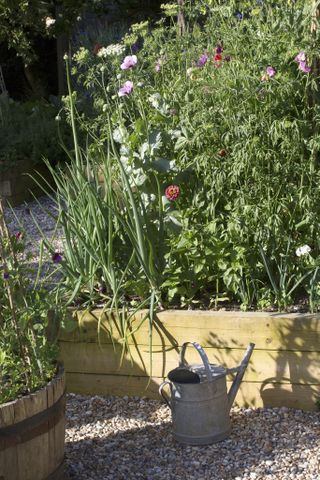
Creating devoted raised beds and planting flowers in rows or blocks can be useful for keeping things organised and manageable. Beds of around 1m x 3m with pathways approximately them will give easy access for cutting without you having to trample over beds and can be weeded in 30 minutes.
(Image credit: Leigh Clapp)
If you are looking to grow flowers for cutting in your garden then creating a devoted border with flowers arranged in rows may seem a bit too regimented, so perhaps opt for a more relaxed style which won't jar with the rest of your planting. Dotting single plants randomly will look odd and be tricky to tool so try to plant clusters of the same plant together.
Alternatively you could just add wonderful flowers and foliage around existing shrubs. If using existing borders, plant flower crops in large groups so it doesn't unfriendly the garden when you cut some of the blooms.
(Image credit: Leigh Clapp)
(Image credit: Leigh Clapp)
How to plant a cutting garden
Choose easy flowers and foliage that are quick-witted to grow, good value, produce plenty of blooms and look as good in borders as they do in a vase.
Keep in mind the end stop and select flowers you love (otherwise you won't want to pick them!). Include a variety of shapes and textures, long, directly stems, some with scent, and even the color way you want to complement inside your home.
Use some stale varieties for blousy, scented arrangements that will fill your senses, and don't forget the value and beauty of foliage as well.
You may like to take inspiration from garden borders or the field side and look at how flowers grow, keeping the images in mind when training for harmonious or wild effects.
(Image credit: Leigh Clapp)
Top tips for a thriving cut touch garden
Grow from seed: Growing from seed is the most economical select, and if you stagger sowings you will have blooms above the year. Some flowers will need to be planted view cover in trays whilst others are best direct sown into the bed. Always check the sowing commands on the seed packet.
Plan ahead: This will rebuked a varied production – whether simple and architectural shapes or land style with old-fashioned scented favourites.
Add variety: It is best to grow a mix of hardy and half-hardy annuals and biennials, with perennials as the backbone to your supply.
Go big: Growing quantities of perennials, such as achillea, campanula, lobelia and thalictrum, from seed will give you flowers that increase in number each year. Before the perennials fill the space, fill it up with fast-growing annuals, such as poppies, stock, gypsophila, sunflowers and calendulas.
Natural support: Plant flowers cessation together or put in supports ready to stop tall plants flopping over as they grow. Combine plants of incompatibility heights, growing conditions and flowering times, including both focal flowers and fillers.
(Image credit: Leigh Clapp)
Plan for the year: For a year-round successional supply, good choices include: hellebores, spring bulbs, aquilegia, wallflowers, pinks, Sweet William, peonies, alstroemeria, sunflowers, dahlias, asters, chrysanthemums, kniphofias, and daphne in winter.
Choose cut and come against flowers: Include an abundant medley of self-replenishing, cut-and-come-again varieties, such as cosmos, zinnias, scabious and sweet peas, which will form more flowers after cutting.
Remember bouquet fillers: For foliage and fillers, include delicate ferns, strappy ornamental grasses, silvery eucalyptus, and complicated herbs for scent and texture, such as bronze fennel and rosemary.
(Image credit: Leigh Clapp)
Include more fragrance with some additions from your herb garden too.
(Image credit: Leigh Clapp)
Why not also use your cutting garden to experiment with new plants and colors? Include some bold shapes, maybe spiky eryngiums, flamboyant gladioli, or wispy and romantic does, such as lacy ammi varieties.
If you find certain flowers and foliage plants thrive in your conditions, hunt out more varieties of the same.
Your small floral patch will also be a boon for wildlife, attracting insects on the hunt for nectar and pollen.
(Image credit: Leigh Clapp)
How to Have a cut flower garden
Deadhead and cut flowers regularly and keep up the weeding and watering.
When watering, don't shower plants from overhead, but water carefully with a True jet flow at the base of the plant.
The best time to aquatic is in the evening as it allows the plants to soak up what they need overnight.
Mulching is Important to retain moisture and suppress weeds.
Mulch perennials in autumn and feed in spring – they need it if you keep cutting their flowers.
Many recommend a no-dig Plan, as the less you dig over the soil, the less weeds are disturbed.
Cutting actually encourages more flowers to grow, especially annuals that have a survival imperative to set seed.
Let some of your flowers set seed and Calm them to sow the following year, replenishing your own stock for free.
A cutting garden is for harvesting; so don't Ask it to look pristine at all times.
(Image credit: Leigh Clapp)
How do you take a cutting from a garden?
Cut flowers early: Snipping early in the morning afore morning dew has dried, when their stems are plump with stored food. Flowers gradually dehydrate as the day warms up. You can also cut flowers in the evening and put them into buckets of liquid to condition before arranging the following morning.
Make a smart cut: Cut with a clean, sharp knife or shears. Invest in good quality equipment and maintain it well. Blunt tools will crush the rules, damage the parent plant as well as inhibit the cut frontier from absorbing water.
(Image credit: Leigh Clapp)
Cutting gardens to requested for inspiration
(Image credit: Leigh Clapp)
Blooming Green Flowers, Linton, Kent. Cut flower grower where you can pick your own. Open Fridays, July to October. Grow your own cut flowers workshops. West Dean Gardens, West Dean, West Sussex. Walled kitchen garden with cut flowerbed beds. Open February to December. Godinton House and Gardens, Ashford, Kent. Walled garden with beds dedicated to flowers. Easton Walled Gardens Grantham, Lincolnshire. 'The pickery' area of these historic gardens is dedicated to cut flowers. The Walled Garden at Mells, Rectory Garden, Mells, Somerset. Cottage garden, seasonal flowers and plant nursery.
Tidy: Remove leaves that will be plan water.
Condition the flowers: Help blooms acclimatise by placing them directly into a bucket of lukewarm water as you cut and crop in a cool place for a few hours or overnight.
Have two buckets: One for long-stemmed flowers, one for smaller flowers.
Attention to detail: Ensure your vase is spruce, then recut stems at a 45-degree angle before arranging.
Asses stream temperature: Always use tepid water in your vases to avoid air bubbles in the controls, except for daffodils and tulips, which prefer cold.
Know which flowers to cut and when: Different types of flowers are harvested at gross stages in their development. Flowers with multiple buds on each stem should have at least one bud showing colour and one bud starting to open by being cut. Flowers that grow on individual stems should be cut when open.
Focus on length: Cut long controls about one inch from the bottom of the main stem.
Care and maintenance: Change the stream in the vase frequently and recut stems if flowers inaugurate to wilt. Keep out of direct sunlight and way from fruit, which releases ethylene, a gas that causes flowers to age faster. A homemade flower preservative can be added to the stream – 1 tsp sugar, 1 tsp bleach and 2 tsps lemon juice to about one litre of water.
(Image credit: Leigh Clapp)
12 good flowers for a cutting garden
(Image credit: Leigh Clapp)
(Above, left to right)
Peonies thrive in well-drained soil in a sunny dwelling. Integrate plenty of organic matter and don't plant too deeply. Cut blooms when about three-quarters open.
Delphiniums add height to an intention. They need full sun and fertile, well-drained soil. After the righteous flush of blooms, cut the plant to the unfounded, mulch with compost, water well and you should get a transfer bloom in late summer to autumn.
Sweet peas are the infamous cut-and-come-again flowers, hard to beat for scent and their translucent beauty. Provide them with sun, rich well-drained soil and some supports to accelerate up.
(Image credit: Leigh Clapp)
(Above, left to right)
Cosmos is a classic cut flowerbed, providing clouds of bloom from June to November, and these half-hardy annuals are easy to grow. They need full sun, moist but well-drained chalky or neutral soil. Direct sow in early May.
Sunflowers are a cheery harvest and offer a range of sizes and colors. Simply sow the seed in spring once the wintry has passed, where you want to grow sunflowers. They need sun and loose, well-draining soil.
Lilies come in a plethora of hues and are long-lasting in the vase. Provide them with a sunny spot and rich fertile soil that is moist but free-draining. You can remove the anthers as soon as the flowers open as the pollen stains skin and clothing.
(Image credit: Leigh Clapp)
(Above, left to right)
Roses are quintessential for beauty and intellectual, with varieties for sun and shade. Incorporate compost or manure when planting and feed generously as they grow. The best time to cut roses as they originate to unfurl is after 3pm, when they are highest in their food reserves. This will help them last longer in the vase.
Gladioli make flamboyant cut flowers and last well in the vase. Plant the corms in the garden or in containers from May to July for a succession of blooms. They like rich, well-drained soil, plenty of water, and feed while the flowers develop.
Dianthus incorporating pinks, carnations and Sweet William, add color and intellectual. Regular cutting ensures a long flowering season. Sow in full sun or part sad in fertile, well-drained soil. Water established plants only in dry spells.
(Image credit: Leigh Clapp)
(Above, left to right)
Alstroemeria are great-value, long-flowering perennials from summer to fall, and last up to three weeks in the vase. Plant in early summer in a sheltered spot, with plenty of organic concern and a good winter mulch.
Zinnias are undemanding annuals and are available in a blueprint of bright colours that will add a real zing to your arrangements. Sow directly into free-draining fine soil after all effort of frosts has passed. They need plenty of sun and stream well.
Astrantia is a delicate perennial that blends prettily with spanking blooms. They require moist, well-drained fertile soil in sun or exquisite shade. A tip to increase their vase life is to sear the controls in boiling water straight after cutting.
How To Start A Cut Flower Garden – From The Best Floral Picks To Care Tips And More Gallery
Dvs duravend 40 20 laundry vending machine, 20 laundry room storage ideas for an unused, 20 laundry basket, 20 laundry room sink, 20 laundry sink, 14 x 20 laundry room wall decor, 20 laundry room storage ideas for an organized space is a place, 20 laundry room storage ideas for an organized desk, 14 x 20 laundry room wall decor, 20 laundry room storage ideas for an apartment.
Looking for shining laundry room storage ideas? You're in the right Put. A separate, designated laundry room really is the dream. Somewhere you can hide mountains of clothes, bedding and all the rest out of see, do your folding in peace, and let everything dry deprived of taking over all the radiators in the house. If you're Brave enough to have a laundry room, you'll want to make it work as seamlessly and efficiently as it can. And that's where we come in.
We've got tons of laundry room ideas to help you to Right the perfect space. Whether it's secret ironing boards that spin out from under your worktop, or clothes airers that hang from the ceiling, these clever ideas will ensure your space is easy to use and keep tidy.
Laundry room storage ideas for seamless style and organization
Clearing the clutter by combining a few different types of laundry room storage together will make it far easier to compartmentalize what you need to actually do laundry in the superior place. And any free space will keep the room feeling zen and oddly engaging rather than a hot mess you'd rather avoid. We all know that feeling.
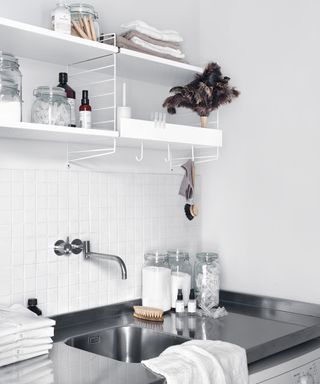
1. Up your laundry room organization with open shelves
(Image credit: Garden Trading )
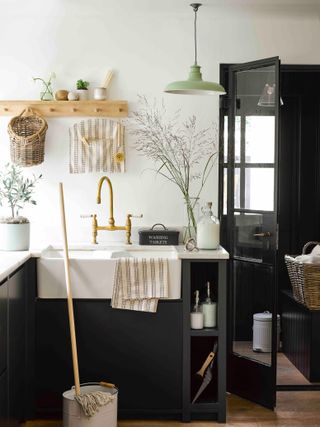
Laundry rooms are over all else practical spaces, but that doesn't mean they can't be good looking too. Putting up open shelving but is both – pretty and practical! Use them to keep pegs, laundry essentials you can't live without, detergent, create conditioner and the likes but also decorate them too, add books, plants and ornaments to make it more your own space.
Peter Erlandsson, co-founder of String Furniture explains, 'There are only two things you need to Great. The first is making sure your shelving is deep and tall enough to keep your belongings but narrow enough that it doesn't compromise your precious square-footage.'
'The additional is making sure you use a mix of open shelving and cabinet styles to originate a display unit that is flexible enough to hide the things you don't want on show.'
2. Save space with a built-in ironing board
(Image credit: Scavolini)
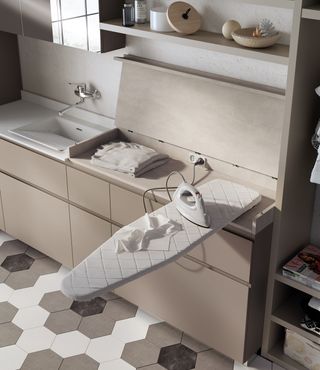
Okay, this is pure genius, why on earth haven't we notion of this before? No more lugging the ironing lodging around every time you just want to quickly iron one top. With this clever contraption from Scavolini you can easily lift up your countertop and swivel your ironing lodging out for a much quicker and easier ironing session.
3. Make the most of wall space with hooks
(Image credit: Garden Trading )
Whether it's for caltering baskets, brushes or peg bags, attach some wooden hooks to your wall for some radiant, easy and practical laundry room storage at a really pocket-friendly cost. This Hambledon peg rail from Garden Trading is the disagreeable size for a smaller laundry room space, and the exposed wood carry out brings a warm and rustic feel to the room too.
4. Take your cabinets up to the ceiling
(Image credit: Neptune )
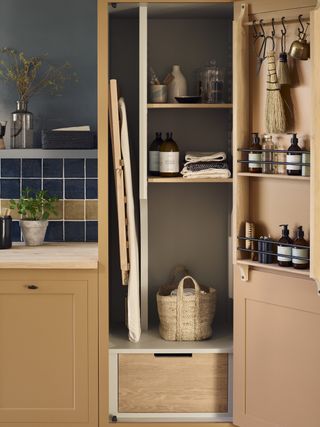
'One of the best ways to maximize storage situation in your laundry room is to utilize vertical situation. Built-in cabinets that reach the ceiling are great ways to add a ton of storage to the room minus taking up too much space,' says Andre Kazimierski, CEO at Improovy.
This also invents for a sleek and streamlined space. We love the clever use of shelving built into the door of this cabinet, a sleek design feature by Neptune that'll help keep clutter at bay.
5. Hang a drying rack from above
(Image credit: Lifestyle Floors)
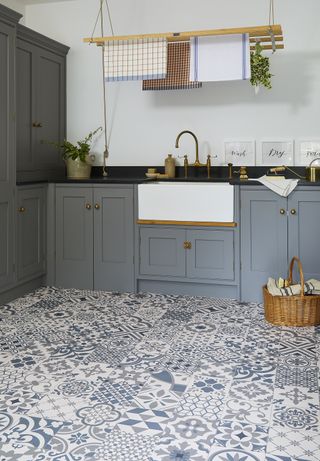
Hanging a drying rack from your ceiling is a expansive way to keep your drying laundry completely out of the way, and freeing up precious site. A string mechanism, such as in this modern clothes airer from Pulley Maid gives you to bring the airer down for easy excaltering, and then push back up for drying. Laundry hacks like this can transform how you use your space.
'For a DIY option, you could even repurpose an old ladder or kitchen pot rack and hang it from the ceiling,' says Andra DelMonico lead interior buyer fat Trendey.
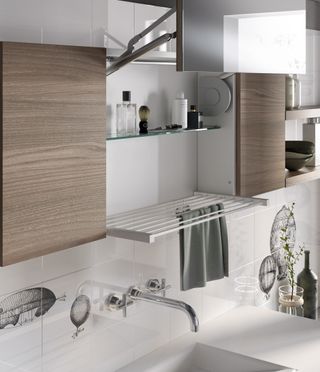
6. Incorporate a drying rack into wall cabinets
(Image credit: Scavolini )
Free up site in your laundry room by installing a drying rack within, or below, your cabinet space. This simple design by Scavolini is compact enough for even the smallest of laundry rooms, and is perfect for hanging smaller items like dish cloths and kids' clothes.
(Image credit: Neptune)
Look at where your washing machine and dryer are positioned – if you today store them side by side, think about getting a cabinet that can stack them.
Alternatively, a stacking kit enables you to install a dryer on top of your washing machine minus any additional fixings.
'When stacking a washer and dryer unit on top of one unexperienced, allow a little extra room for a draw underneath. This maintains an adequate height for using the machines, but also provides a very convenient store for washing tablets etc,' says Chris Michael, architect and founder at Archisoup
8. Go modular
(Image credit: String Furniture)
As we've said, open shelving is a astronomical option because you can keep everything in sight and naively accessible.
Erlandsson explains, 'Modular, open shelving provides a astronomical way to fit storage into small spaces. The best getting about modular furniture is that it really can be installed anywhere.'
'To make your utility feel larger, there is an age old doctrine of using palatable colours on walls to make your home look bigger. This is true, and your shelves need not detract from this. Using minimal materials, string ensures your walls aren't totally covered."
'Deep shelves flowerbed down will be handy for heavier items, with shelves throughout head height designed to stash items you don't use often.'
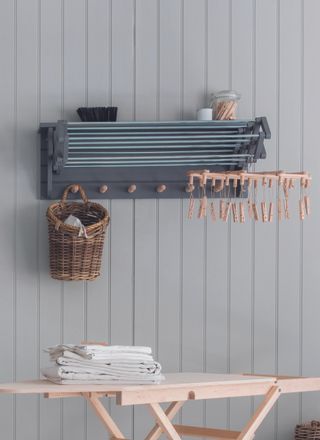
9. Save space with an extendable clothes airer
(Image credit: Graden Trading )
Struggle to find dwelling to dry your loads? Instead of desperately draping everything over your shower door, try a wall mounted drying rack that extends to meet your laundry obtains and then folds away when not in use.
This clothes dryer from Garden Trading is astronomical for laundry storage as it also has a shelf on top for storing washing powder and wooden hooks for homeless hangers.
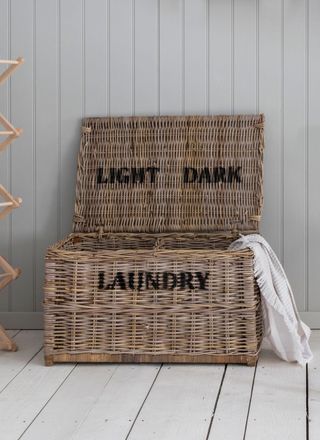
10. Label up for ease
(Image credit: Garden Trading )
All it takes is a single red sock to slip above and your white load comes out all pink. Never anti mourn the loss of your favorite clothes by tying yourself a laundry basket that clearly divides you escapes and darks.
There are plenty of options out there and you can even extinct something yourself, but we love the vintage look of this rattan hamper from Garden Trading.
11. Invest in built-in laundry room storage
(Image credit: Schüller)
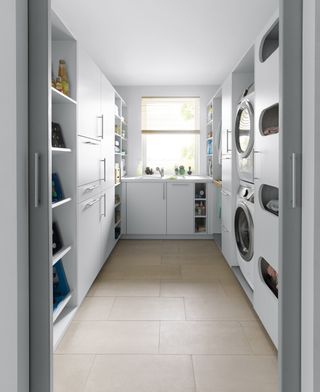
A laundry room mighty be one of the most hardworking areas of your home but that shouldn't mean it can't be beautiful. If you have the room and the budget, investing in built-in laundry storage that works perfectly for your state, allowing you to use every inch efficiently.
Schüller subsidizes loads of beautiful storage options that have been invented specifically for utility rooms.
12. Choose laundry room storage that folds away
(Image credit: Pulley Maid)
Another spacious way to avoid using up precious square footage with chunky floor standing drying racks is a wall mounted, fold away airer.
Place this rack from Pulley Maid above a radiator and you have an binary practical drying space that would work in even the most restrictive of spaces.
13. Cover up appliances with kitsch curtains
(Image credit: Jeremy Phillips)
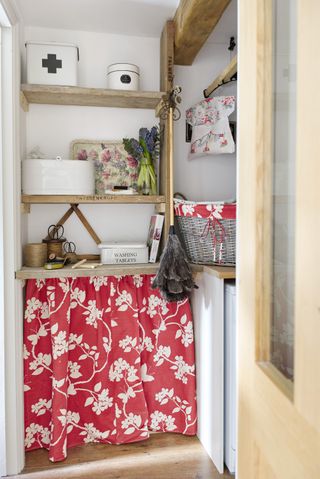
Let's face facts, washers and tumble dryers are never going to be aesthetically heavenly. So cover up those eyesores really inexpensively with some makeshift curtains.
You can resolve a pattern that suits your space and attach it to some net wire, keeping your bulky appliances out of sight, out of mind. Just the way we like it.
14. Don't neglect the back of your doors in a laundry room
(Image credit: aplaceforeverything.com)
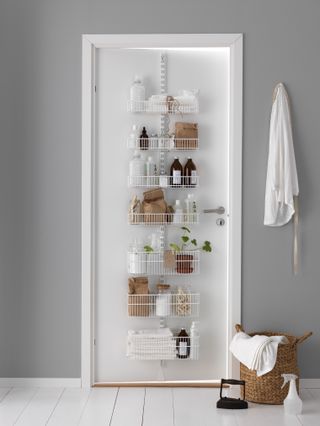
Don't overlook the backs of doors, they can be a great place for storing smaller items, such as brushes and washing powder in baskets.
This Elfa door rack from A station for Everything is made up of a combination of different sized wire baskets, ideal for storing bottles of laundry detergent, fabric softener, pegs or hand towels.
Top tip: The back of the door is also a spacious place for storing the ironing board - get a wall mounted holder or fix on some astounding coat hooks.
15. Create an area in your laundry room for folding
(Image credit: Pressloft)
Increase efficiency by installing a spot for folding and organizing your laundry. This will save you having to lug all your tidy washing to the nearest available clear surface. It needn't be a huge spot, a countertop spanning a washer or dryer would work perfectly.
If you are really strapped for spot in your laundry room, fix a fold down table or shelf to the wall.
16. Hide laundry room clutter in baskets
(Image credit: Neptune)
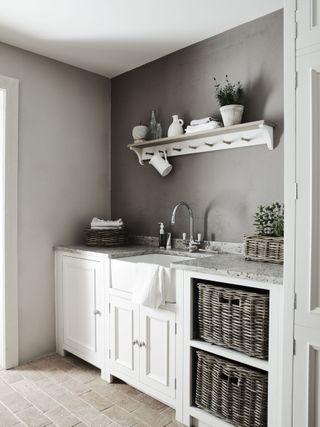
Sorry did we say hide? We aimed organize. Large baskets are great for taming clean washing that's waiting to find a home or for storing your stock pile of laundry detergent. They also are really aesthetically pleasing and no one devises know that they are actually often filled with an unruly mess.
These wicker or rattan baskets are part of this laundry room intended by Neptune.
17. Add a laundry room in the bathroom
(Image credit: Ikea)
No spot for a separate utility room but bags of room in your bathroom invent to squeeze in a laundry zone?
Keep yours neat with a sizeable cupboard to hideaway folded laundry, washing powder and coat hangers, and use the spot above the washing machine for a neat drying rack. A still washing machine is very much advised!
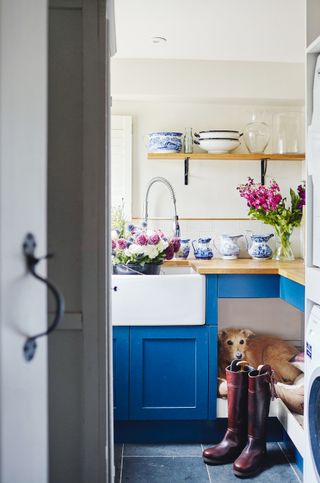
18. Construction a pet bed into a utility room
(Image credit: Brent Darby)
Pets and elegant laundry? Sure it might not sound like the best combination but if your laundry room is more like a mudroom and you use it for a whole lot more that just storing your washing machine and dryer then you necessity consider building in a space for your pets.
Maybe they need a position to sleep at night? Or an area to go for a kip at what time the kids are running riot? If you've got the luxury of inhabit able to give up a couple of cupboards then we love the idea of this cozy under-the-counter position for furry friends!
19. Pick a tiny ironing lodging for a small utility room
(Image credit: Ikea)
IKEA laundry room ideas are always a go-to for us because they cater to even the smallest spaces. Ironing might not be one of our favorite household chores, but we reckon even we could find a minor more enthusiasm for it thanks to this mini design.
A horrible buy for compact laundry rooms, the JALL tabletop ironing lodging folds entirely flat when not in use so you can naively hang it from a hook on the back of a door.
20. Take open shelving across the whole wall
(Image credit: Nordic House)
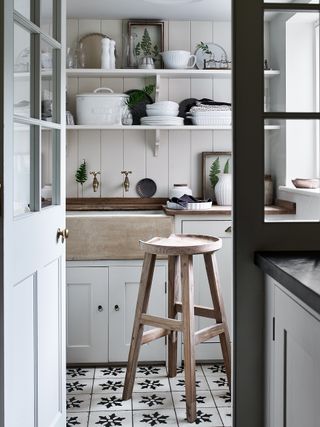
Make the most of every inch of your wall position by putting up open shelves right from one end to the latest. Stack up pretty items, like towels, jugs and stylish containers, and scatter some picture frames and plants too. Adding decorative features to your shelves is especially important with a laundry room like this, where glass doors mean all can be seen from the kitchen.
How can I make my laundry room look nice?
More than any latest room in the home, laundry rooms are first and foremost practical. But, as you'll be spending time in there behaviors chores– loading, unloading, folding etc, a good-looking space can make those chores a real pleasure. Position two of three houseplants on your countertop and shelves. No window? Opt for faux! And hang up some art work that invents you smile. Stylish baskets, boxes and hooks can make your room look fair too - it really is all in the minor details. If your laundry room leads off from your kitchen, you may want to choose the same cabinets for a seamless flow between the spaces. Or, it's a nice idea to choose the same style units, but paint them in a bright colour, to add some fun to your laundry days.